The Beetle That Lives in the Wood
Last fall I planted some new quince trees. It's a fruit I really like. It's not an apple, it's not a pear, but it's something in between those two. It needs to be cooked to unlock its floral, pear-like flavor and turn its white flesh into deep pink or red. My wife uses it to make quince-applesauce (50/50 apples and quince) and jam. But cooking tips aside.
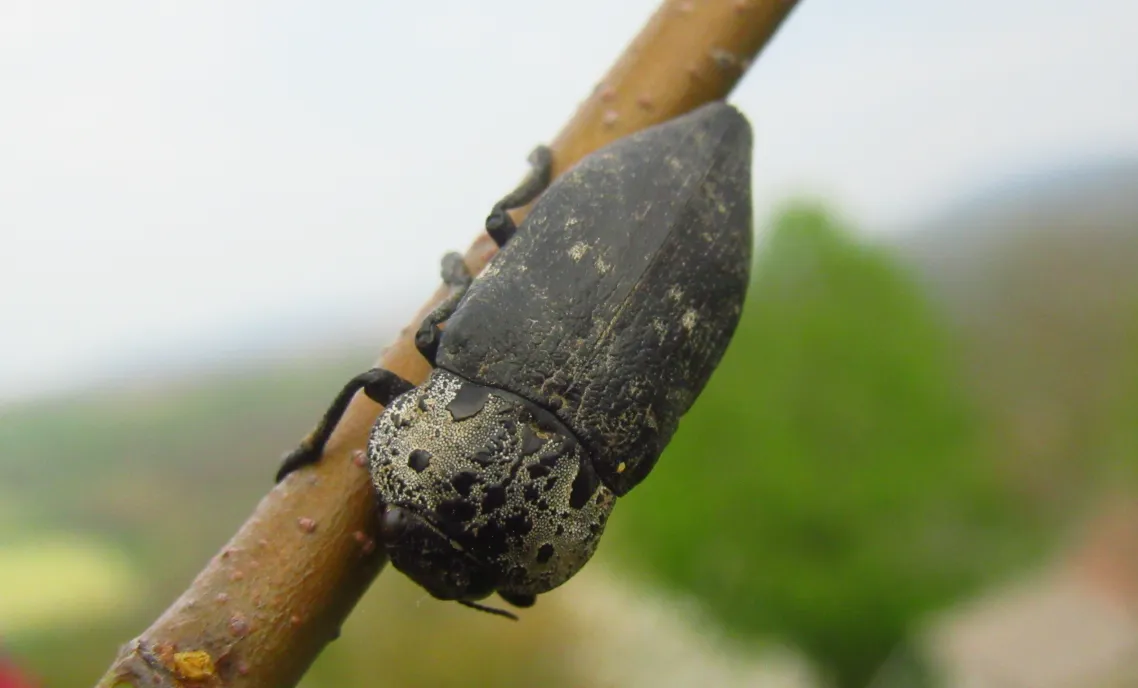
Today I noticed something dark clinging to one of the young branches. At first glance, it didn’t even register as an insect. It looked like a fragment of bark, or a small piece of charcoal wedged against the twig.
But then it moved and it became obvious that it was a beetle.
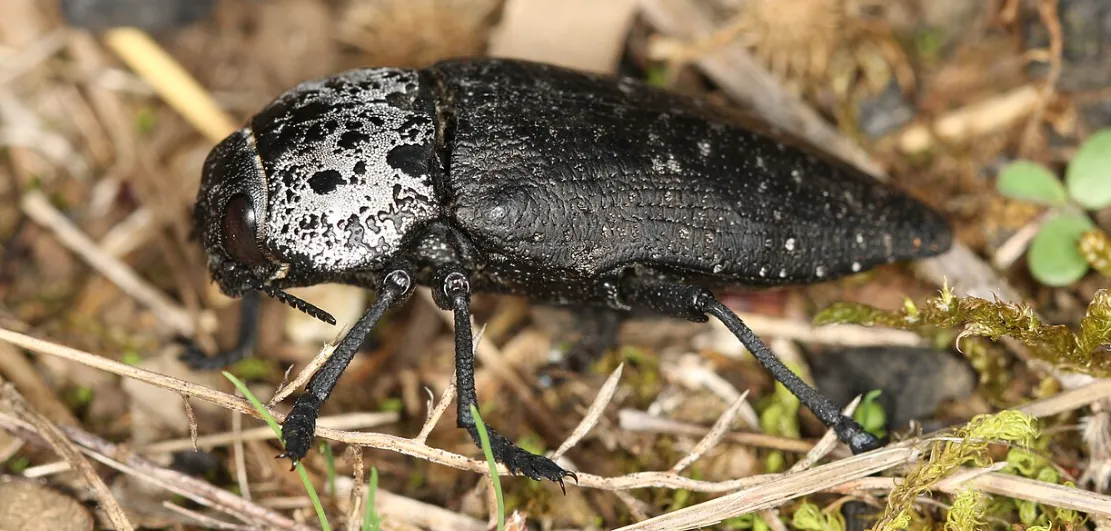
A thick, heavy, matte black beetle, with a surface that looked almost scorched. Its head tucked down, as if withdrawn into its body, and its back a smooth, armored dome. When I got closer, it did what many of its relatives do best: it froze completely, trying to become indistinguishable from the tree it sat on.
This was Capnodis tenebrionis, the flatheaded root borer.
A Beetle Built Like Stone
There is something unmistakably ancient about beetles like this. Capnodis belongs to the family Buprestidae, the jewel beetles, a lineage that stretches deep into evolutionary time. Fossil evidence places early relatives of these beetles well into the age of dinosaurs, when forests were already filled with wood-borers carving their lives into trunks and branches.
Most jewel beetles are known for their metallic brilliance, flashing greens and blues that are often described as living gemstones. But Capnodis tenebrionis has gone in the opposite direction. It has abandoned all the shine for camouflage. Its dull, black surface absorbs the light rather than reflecting it. It does not advertise itself. It disappears. This is not a beetle that relies on being seen.
A Life Hidden Underground
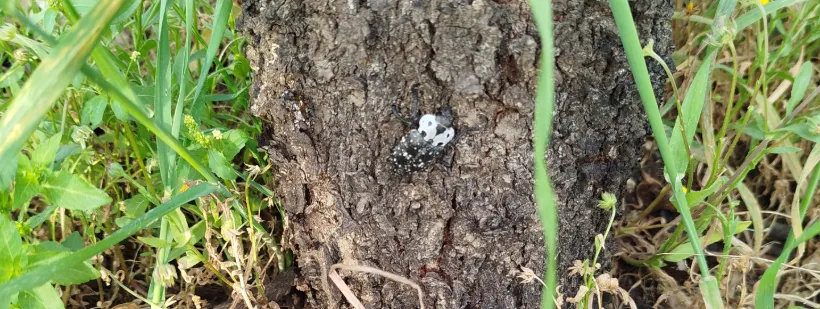
The adult you see on the branch is only a brief chapter in a much longer story. It spents most of its life out of sight, inside the tree itself.
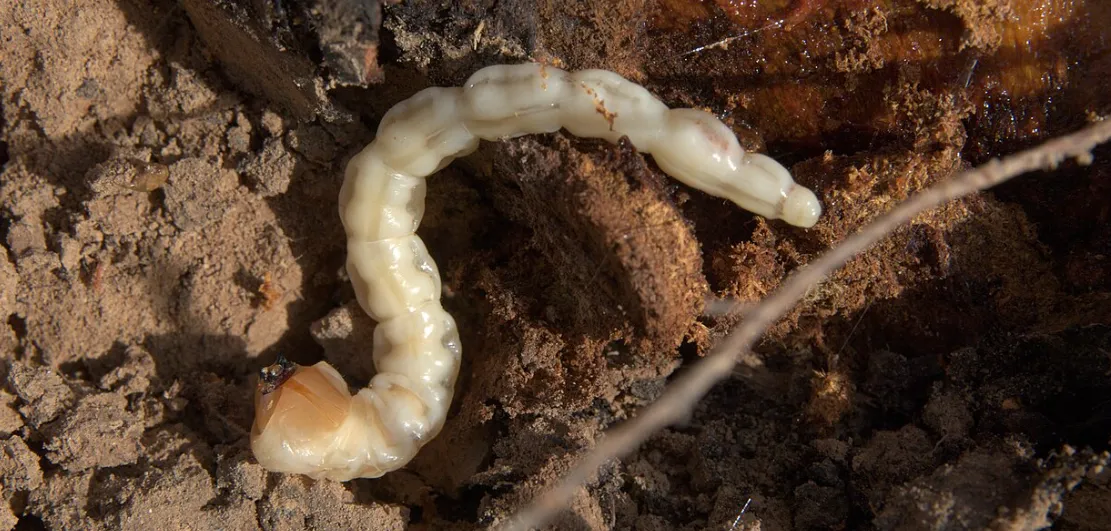
After mating, the female lays her eggs in dry soil around the base of a tree. When the larvae hatch, instead of climbing upward, they go down and in, burrowing into the roots and the lower trunk. There, hidden beneath the earth and the bark, they begin to feed.
They carve long, widening tunnels through the wood, disrupting the flow of water and nutrients. Over time, this feeding can weaken a tree, sometimes even kill it. In orchards the beetle has earned its reputation as a destructive pest. A single infestation, left unchecked, can kill a tree within a couple of years.
But if we look at it from another perspective, this is not destruction but rather transformation.
The larva is not attacking the tree out of malice. It is doing what wood-borers have done for hundreds of millions of years: turning solid wood into living tissue, converting structure into energy and slowly recycling what would otherwise remain locked away.
Heat, Light, and Stillness
The adult beetles emerge in spring, when the temperature rises. They are creatures that love warmth and only become active when the sun is strong enough. You will often find them on the sunlit side of a tree, angled toward the light, absorbing as much heat as they can. They are not particularly fast, but they don't need to be. When disturbed, they don’t flee. They freeze. They trust their shape and color to protect them. And often, it works just fine.
Looking at the photographs, you can see how well this strategy functions. The beetle doesn’t contrast with the branches and bark, it merges with it. It becomes part of the tree’s texture.
The Reputation Problem
If you search for Capnodis tenebrionis, pretty much everything you find will describe it as a pest. And it is, undeniably, in the context of orchards. It targets fruit trees, mainly apricot, peach, plum, almond and cherry, and sometimes... yes quince...
It prefers trees that are already stressed: drought-weakened, neglected, or newly planted.
From an agricultural perspective, it is an enemy.
But that framing is a bit too narrow.
In a wild or semi-wild setting, beetles like this are part of a much older system. Wood-boring insects tend to select weakened hosts not by accident, but because those trees are already entering a different phase of their life cycle. The beetle becomes part of the process that turns a living tree into habitat, into soil, into something else.
It is less of a destroyer than a signal: 'This tree is no longer at its strongest'.
Why This One Matters
What makes the observation interesting is the context.
I planted that quince last fall. It is young, still establishing and, at the moment, vulnerable. And this beetle found it.
Now, this doesn’t necessarily mean my tree is doomed. But it does mean something subtle is happening. Either the tree is slightly stressed, maybe transplant shock, maybe water conditions or it doesn't really like the soil in my garden.
Or maybe the beetle is simply exploring the edges of its territory and isn't interested in my tree at all?
Either way, I've caught the interaction at its earliest stage: not yet as damage, but as presence.
A Different Way of Looking
It’s easy to see a beetle like this and immediately think in terms of threat.
But if you step back for a moment, what you’re looking at is something much older than the garden, older than orchards, older even than flowering plants as we know them today.
It's a lineage of insects that has learned, millions of years ago, how to live inside wood.
A life cycle that is split between sunlight and darkness. An adult basking on a branch, a larva tunneling through roots... both are part of the same continuous organism.
And for a brief moment, these two worlds meet on the surface of my tree.