The Green Background
The Invisible Forest
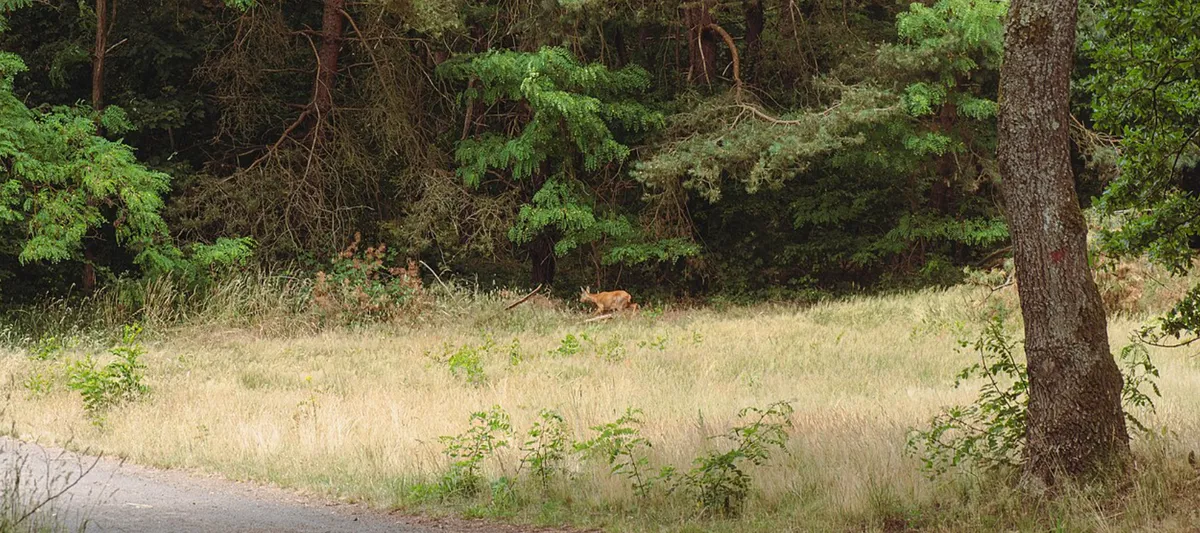
This is a picture I use sometimes as a small test.
It shows a woodland scene, with a deer standing in a clearing, surrounded by trees and undergrowth. When I show it to people and ask what they see, everyone mentions the deer first, while it is by no means the most obvious thing in the photo. Most stop there, after mentioning it, as if the rest of the image is simply background. The trees, the shrubs, the ground plants, the moss on the bark, all of it registers, if it registers at all, as scenery.
The deer is the subject. The plants are the stage.
This is what's called 'plant blindness'. And almost everyone has it.
A Name for Something You've Always Done
The term was coined by two botanist educators, James Wandersee and Elisabeth Schussler, in a 1999 paper called 'Preventing Plant Blindness'. They defined it as
Plant blindness: the inability to see or notice the plants in one's own environment, leading to the conclusion that they are unworthy of human consideration.
It's quite a bold phrase. But the more you think about it, the more accurate it feels.
Think about the last time you walked through a park or a garden and came home excited about something you'd seen. The chances are good that it was a bird, an insect, a mammal or maybe even a weather event. The chances are considerably lower that it was a plant, unless it was something obviously spectacular, a tree in full blossom, a field of wildflowers... something that demanded your attention through sheer scale or colour.
The rest of the plant life you walked through? Background.
Why Our Brains Do This
It isn't laziness or ignorance. It's biology. Wandersee and Schussler suggested that several plant characteristics, like their uniform colour (all green), their tendency to grow in groups, their lack of movement, and their lack of a face, all have an effect on how humans process visual information. Our brain is fundamentally a difference detector. It looks for things that move, things that change, things that stand out from their surroundings. Plants, for the most part, do none of these things. They are green, they are still, and they blend into each other.
The brain finds no difference, and so the perceptual field is not perturbed. The plants are there. You are looking at them. But you are not seeing them.
This isn't a new problem created by all the screens we look at all day. It is almost certainly an ancient cognitive tendency. Our brain is allocating its limited attention to the things most likely to matter for immediate survival. A moving animal might be a predator or prey. A stationary green plant rarely is. So the animal gets processed and the plants get filed under 'environment-noise'.
Research has since confirmed this experimentally. Studies have demonstrated that plants capture human attention less effectively than animals, and that people recall animal names more readily than plant names even when both are equally familiar.
The Consequences
Plant blindness would be a minor curiosity if it only affected which things we notice on a walk. But it goes considerably deeper than that. Plants make up around 80% of all biomass on Earth and play important roles in almost all ecosystems.
They produce the oxygen we breathe, form the base of almost every food chain, stabilise soils, regulate water cycles, and support virtually every other form of life on the planet. Plants comprise up to around 450 gigatonnes of carbon of the total 550 gigatonnes in all of Earth's biomass, compared to just 2 gigatonnes for all animals.
And yet they are largely invisible to us.
Plant science research has been defunded, interest in botany degrees has decreased, and plant biology courses have been discontinued. While doing some research, I found some numbers from the UK, where the last student enrolled in a pure botany degree began their course over a decade ago. The number of zoology and animal biology degrees available vastly outnumbers plant science ones. A search of university admissions in the UK found nine botany or plant science degrees available, against 53 in zoology and animal biology.
We are systematically underinvesting in our understanding of the organisms that make all other life possible, and part of the reason is simply that most people don't notice them enough to care about them.
The Interesting Twist
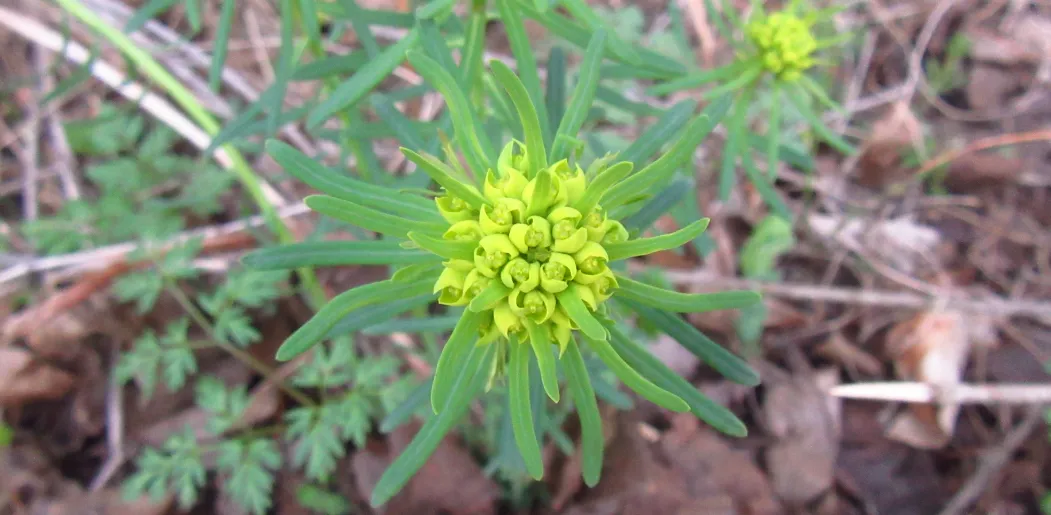
Here is what I find most fascinating about plant blindness: it is not fixed.
Psychologists have found that once objects acquire meaning for an observer, they are more likely to be consciously perceived. In other words, the cure for plant blindness is not effort or discipline. It is knowledge. More specifically, the kind of knowledge that gives you a reason to look.
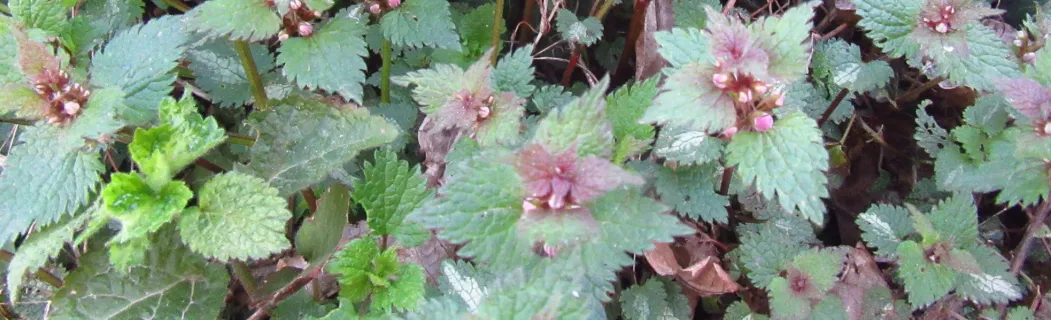
Once you know that the dandelion in the lawn is running two completely different reproductive strategies simultaneously. Once you know that the dead nettle on the path edge has a flower engineered to deposit pollen on a specific part of a visiting bumblebee's body. Once you know that the oak tree you walk past every day is in a chemical arms race with the insects feeding on its leaves, producing tannins that the insects are constantly evolving to detoxify... once you know any of this, the plant stops being background. It becomes a subject.
And once you know, you cannot unknow it. Once a plant has acquired meaning, your brain stops filtering it out. You start to see it. Not just that one plant, but all the others like it, and then the ones unlike it, and then the relationships between them.
This is what learning botany actually does, and it is why I think the traditional way of teaching it, with all the Latin names, lists of features, taxonomic keys that feel like bureaucratic exercises, so often fails. It gives people information without giving them meaning first. The names arrive before the wonder, and without the wonder, the names don't stick.
What the Garden Taught Me
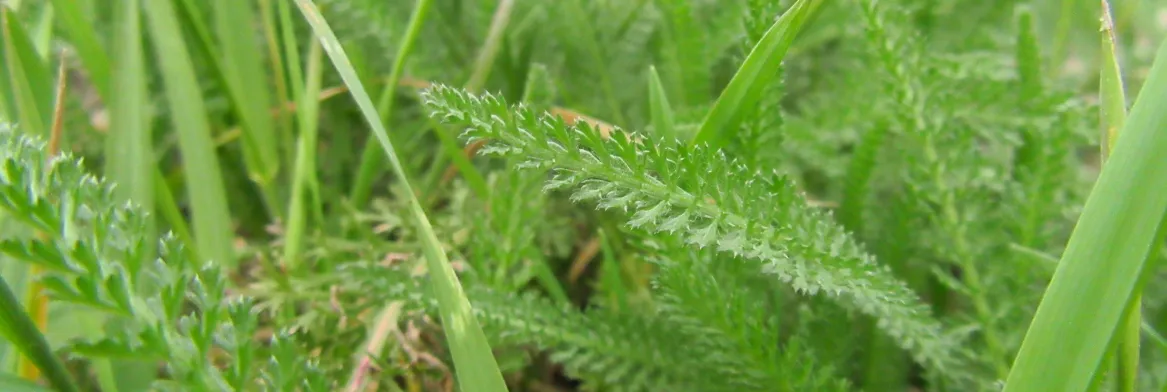
It took me a while to become really interested in plants. Years in fact. My background is in invertebrates in general and beetles in particular. In anything that lives in dead wood or under bark. Plants, for most of my life, were context. The place where the insects lived. The thing I pushed through to get to the thing I was actually looking for.
What changed it for me, was having a garden.
When you see the same plants every day, across every season, something shifts. You notice when the first violet opens, not because you were looking for it, but because it wasn't there yesterday and now it is. You notice which plants the native bees prefer and which they ignore. You notice the dandelion closing its flower in the afternoon and reopening in the morning, which raises the question of why, which leads to an hour of reading, which leads to knowing that the closing is a response to specific light and temperature conditions that also happen to signal poor pollinator activity since the plant is not wasting energy staying open when the visitors aren't flying.
It is watching the same thing over and over again, until it starts to make sense. And once it starts to make sense, the plant blindness will retreat. Not through effort, but through meaning.
And then you get hooked. You start to notice how weird plants are, how much variation there is out there and that all that green you see, is actually one big battlefield, where some species are allies, some are enemies and some just happen to be at the wrong place at the wrong time, all battling for resources, territory, food, water...
The Backdrop Becomes the Subject
Let's go back to the picture with the deer for a second. I fully understand why it's always the deer that people mention when I ask what they see. Movement, a face, an animal with recognisable behaviour... Like I said, it's just how our brain is programmed to function. I am not immune to it either. A fox crossing the garden at dusk will always pull my attention before the plants it walks through.
But the plants it walks through are not just the background anymore.
By now, I know what most of them are. I know something about what they're doing, who visits them, what they're competing with, what they've evolved to attract or repel. The woodland in that photograph, the thing everyone ignores, is one of the most complex ecological systems on the planet, running thousands of simultaneous processes, most of which we are only beginning to understand.
The deer is passing through it.
It's the plants that are the story.