In Defence of the Dung Fly
I came across a bucket in the garden that I must have forgotten last autumn. It is full of walnuts and husks from last season, and since then the rain has been filling it further up. By now the water inside has turned a deep rich brown, somewhere between coffee and ink. I suspect it will make a great natural dye that I can use in my leather-craft, or maybe, if I boil it down to thicken it a bit, it might even be a workable writing ink. A happy accident.
But that's not why I'm writing about it today.
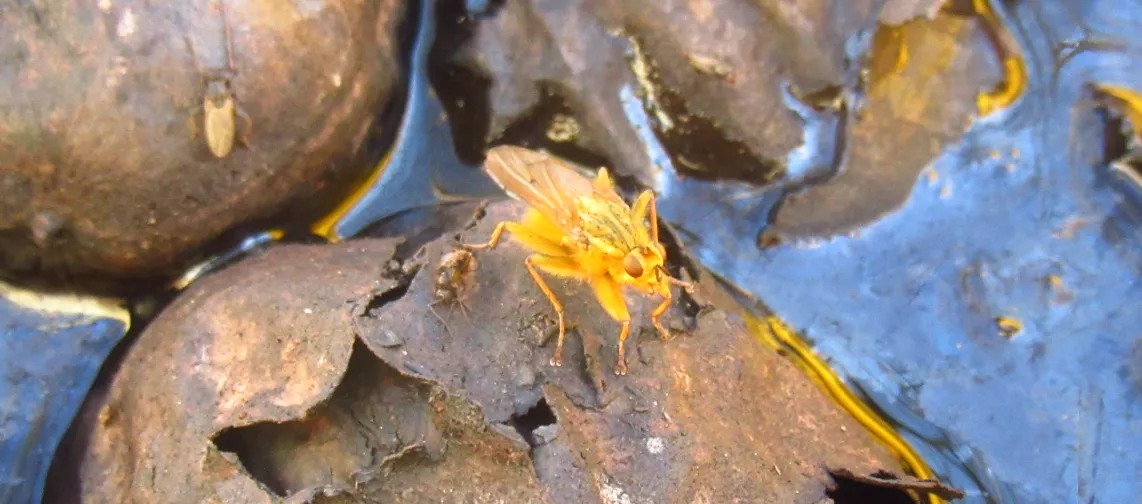
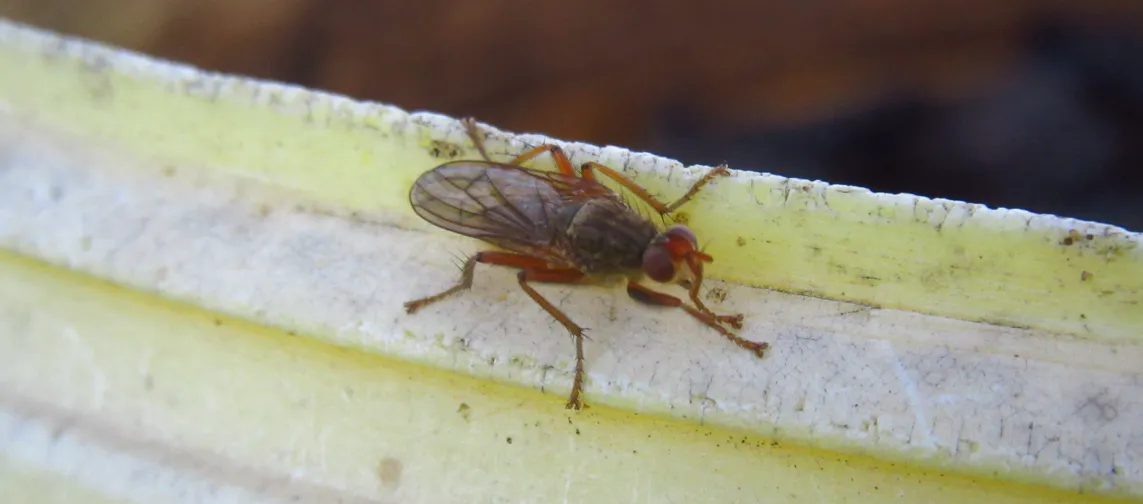
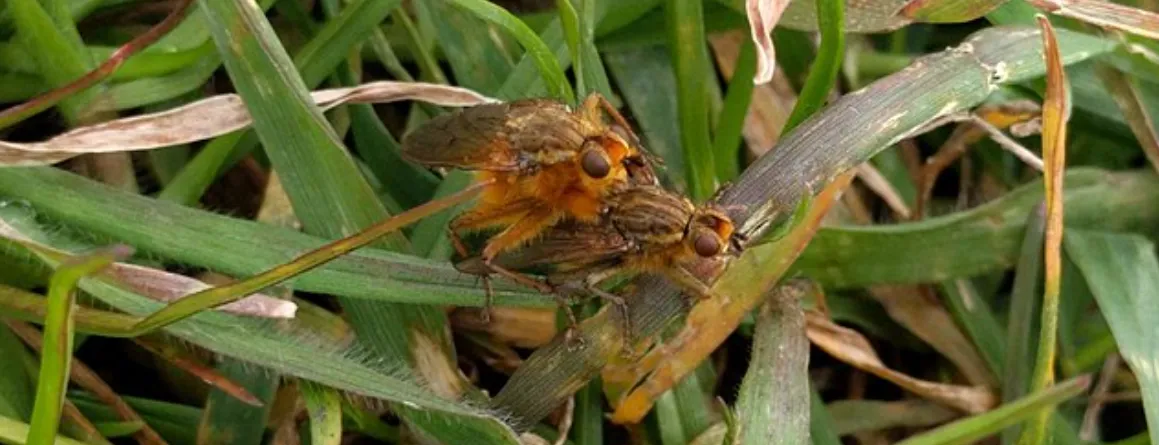
This morning I found a lot of flies around that bucket, hunting. All clearly Scathophaga stercoraria, the Yellow Dung Fly. Vivid golden-orange ones, which are the males, and darker, more muted ones, which are the females. All of them were eating smaller flies that had come to the surface of the water.
Now, most people see this fly and move on, or move away. If they know the name at all, they assume it tells the whole story. Let me tell you; it doesn't. There's a lot more to these flies than the name would imply.
The Name is Misleading
The scientific name is Scathophaga stercoraria.
Scatho, from the Greek 'skatos', meaning 'excrement', and 'phaga', 'to eat'.
Plus 'stercoraria', from the Latin 'stercoris', meaning 'of dung'.
So Scathophaga stercoraria, roughly translate to, 'dung eater of dung'.
This has to be one of the least flattering names in entomology.
Yes, the larvae do develop in dung, primarily the fresh droppings of cattle and other large mammals. That part is true.
But the adults are predators.
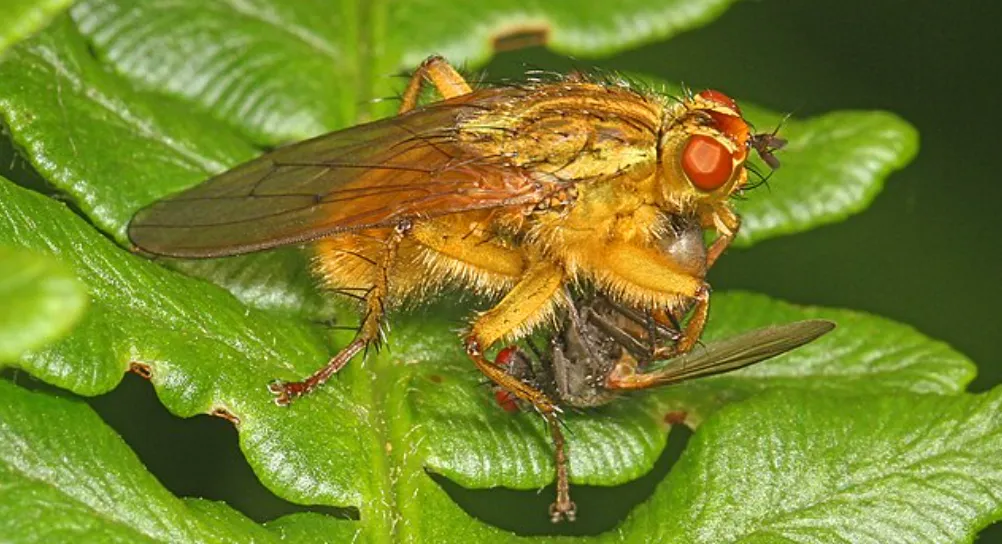
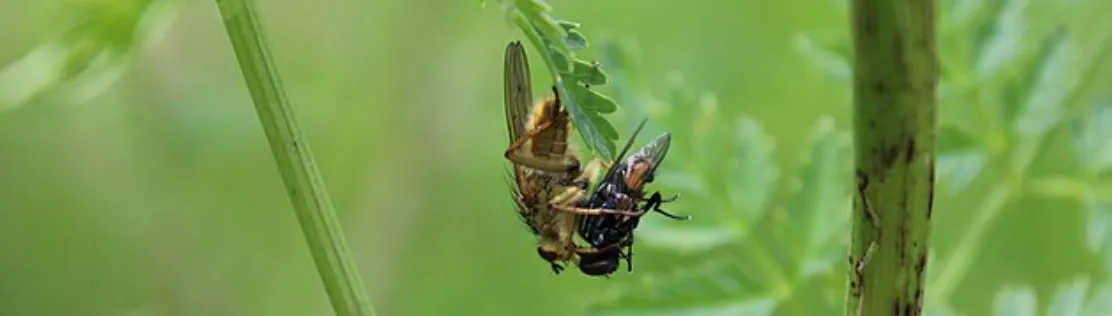
What I watched this morning, these flies hunting smaller insects on the surface of my bucket of 'walnut-water-brew' is what adult dung flies spend most of their lives doing. They are ambush hunters, sitting and waiting for smaller flies, midges, and other insects to come within range, then seizing them with their legs and biting them. In the field, they take whatever is available; flies, midges, small beetles, whatever is small enough to handle.
If you have fruit trees or a vegetable garden, these are exactly the neighbors you want. They are a natural, highly efficient pest control system, working the 'invisible forest' while we aren't looking.
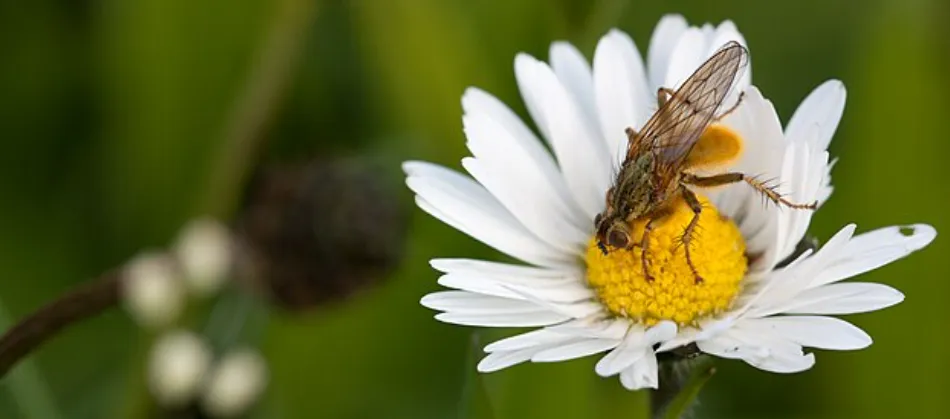
But that's not all they can help you with in the garden. When they aren't hunting, dung flies are surprisingly clean diners and they spend a significant portion of their time on flowers, like the pear and cherry blossoms I now have through the whole garden, drinking nectar for energy.
Because the males are so incredibly hairy (that golden fur is actually a layer of dense setae), they are accidental but effective pollinators. They move from flower to flower, fueling their hunting trips with sugar and carrying pollen with them as they go.
The bright one in the photograph above is the male. That vivid golden-orange colour comes from dense bristly hairs covering the body, almost giving the impression that it is fur. The female is darker and less conspicuous, spending less time in exposed positions than the male. Both sexes are efficient hunters, and all were making good use of the insects drawn to the surface of that bucket.
The Science Behind the Fly
Scathophaga stercoraria is, perhaps surprisingly, one of the most scientifically studied insects in the world.
Since the 1970s, when biologists began a series of landmark studies on its behaviour, the yellow dung fly has become a standard model organism in evolutionary biology. It is often used to investigate sperm competition, sexual conflict, mating systems, and the evolution of body size. It is, in the world of behavioural ecology, roughly what Drosophila (fruit flies) is to genetics: a species whose biology is understood in such extraordinary detail that it has become a reference point for understanding biology more broadly.
The reason it attracted so much attention is its mating system. Males congregate on fresh dung pats and compete intensely for females that arrive to lay their eggs. Larger males generally win fights and secure more matings. But, and this is where it gets interesting, even after mating, the competition doesn't end. Females mate with multiple males, and the last male to mate typically fertilises around 80 percent of the eggs, by physically displacing the sperm of previous males during copulation. This means that simply winning a fight and mating is not enough. A male also has to time his copulation correctly, invest enough sperm to displace rivals, and guard the female afterward.
The mathematics of this, how long to copulate, how much sperm to invest, when to leave and find another female, has been modelled, tested, and refined over fifty years of research. The yellow dung fly is one of the clearest examples in nature of what biologists call sperm competition, and much of what we understand about it as a phenomenon comes from studies on this species.
What It Actually Does for the Ecosystem
The larvae, developing in dung, are doing something genuinely useful. Fresh dung is a rich but temporary resource, and the speed at which it is broken down matters ecologically. Dung fly larvae, along with dung beetles and a wide variety of other invertebrates, speed up decomposition, return the nutrients to the soil and disrupt the development of parasitic worms and pest flies that also use dung as a breeding site. A pasture with a healthy dung fly population has less disease transmission between livestock than one without.
The adults, as predators of smaller flies, provide a form of pest control. Males on a dung pat are not just waiting for females. They are actively hunting the blow flies, house flies, and other species that are also attracted to the dung. This was noticed early enough that in the 1920s, researchers investigated whether dung flies could be used as deliberate biological control agents against pest flies around livestock. The idea was never really developed on a large commercial scale, but the ecological service happens anyway.
A 2023 study confirmed that dung flies are not strict specialists on cattle dung. They use dung from a wide range of wild and domestic herbivores, and their abundance in pastures reflects a shift toward livestock following agricultural intensification. This makes them resilient generalists rather than fragile specialists, and it means they turn up in all kinds of unexpected places, including, apparently, a forgotten bucket of walnut husks in my Hungarian garden.
The Flies on my Bucket
Finding them here, away from any dung, is not unusual. Adult dung flies range widely in search of prey, and any concentration of small insects, whether it's a fermenting liquid surface, a flowering plant or a patch of aphid-infested vegetation will quickly draw them in.
What struck me this morning was how purposeful they were. No aimless wandering. The males especially were working the surface methodically, moving a few millimetres at a time, positioning themselves over something too small for me to see before striking. The females were doing the same thing nearby, occasionally pausing to clean their legs in the way that flies do, before returning to the hunt.
They are not dirty. They are not dangerous. They are just predators doing what predators do, in a body that happens to be the colour of one of the most precious metals on earth, but with a name that tells you almost nothing useful about how they actually live.
Next time you see a yellow fly, don't reach for a swatter or turn away in disgust. Just watch it for a couple minutes. Look at the way they hunt. Admire the precision of their strikes. You aren't looking at a pest; you’re looking at a golden hunter, and the world is a lot more functional because he’s in it.