The Hedge That Doesn’t Pretend to Be Alive
I have been pulling grapevines out of the vineyard for several days now.
Six hundred and fifty vines came with the house. Far too many for someone who enjoys drinking wine more than producing it. So slowly, row by row, I am removing them, to replace them with a variety of other fruit species later this year. The wood piles up quickly. Long, twisted stems, pruned canes and old posts.
The easiest thing would be to burn it. It's what the neighbors do with all their fallen branches and prunings. They pile them up, pour some gasoline on them and watch them burn while drinking a beer. I'm not going to do that.
The second easiest thing would be to haul it away. I'm not going to do that either.
Instead, I am building a dead hedge.
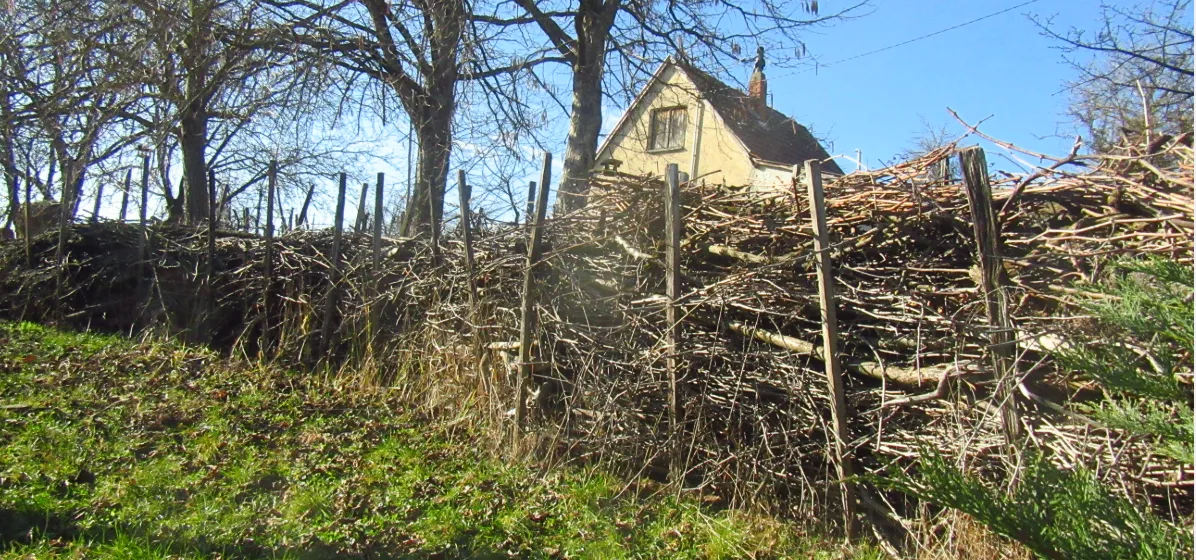
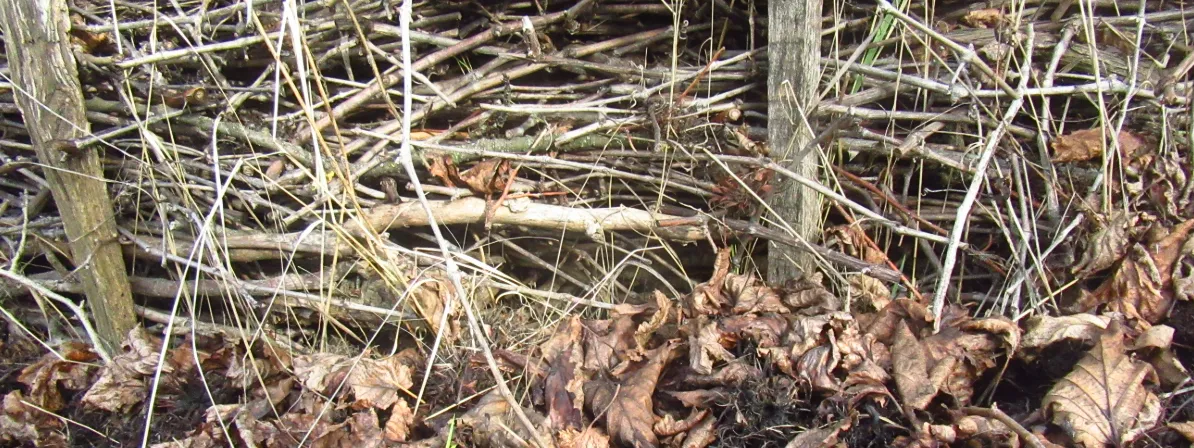
At first glance, a dead hedge looks like neglect. A messy line of stacked branches held in place by upright stakes. It doesn’t bloom, it doesn’t impress and it doesn’t signal effort in the way a neatly clipped evergreen hedge does.
I don't care, I like the way it looks.
In my opinion, a dead hedge is one of the most honest structures you can build in a garden.
A living hedge pretends to be permanent. It demands trimming, shaping and controlling. A dead hedge makes no such promises. It announces decay from the beginning. It is a slow structure. It settles, it collapses inward and it sinks year by year.
But that sinking is not failure, it's transformation.
When you stack cut wood and fallen branches between stakes, you are not creating habitat in the decorative sense. You are interrupting the usual cycle of disposal. In most managed landscapes, plant material is removed. Burned. Shredded. Exported. All the nutrients leave the system.
A dead hedge keeps them here.
Rain will soak into the wood. Fungi will begin their quiet work. Moss will appear on the shaded side. My sheep will scratch against it. The dogs will patrol along it, noses low, sniffing out whatever has taken shelter inside. Beetles will come, of course, they always do, but so will spiders, small mammals, overwintering amphibians and maybe even some small songbirds will hide their nests inside.
And then, something less visible will happen.
The wind will slow.
A dead hedge is porous. It doesn’t block wind like a wall; it diffuses it. Snow gathers differently around it. Seeds accumulate in its base. Over time, the soil beneath it changes. It becomes darker. Looser. Richer. It creates a new micro-ecosystem where now plants can grow that otherwise couldn't.
It is a boundary, but not a hard one.
I like that. The one I'm building blocks the view from the road, diffuses the neighbor's sounds, and still looks organic and natural.
The vineyard rows are straight, controlled, productive. The dead hedge is irregular. It bends slightly. It leans. It absorbs what would otherwise be considered waste.
There is something deeply satisfying about turning removal into structure. About taking what was once cultivated for yield and letting it become refuge instead.
It is not beautiful in the ornamental sense.
But it feels right.
When I look at it, I don’t see a pile of branches. I see stored sunlight. Years of growth returning slowly to the ground. I see a line that separates 'managed' from 'left alone'.
In a few years, it will look less like a construction and more like part of the landscape. That is the goal.
Not permanence.
Not control.
Just participation in decay.