The Plant That Got It Half Wrong
Walking the dogs like I do every day, my eyes eventually get used to the certain rhythm of green all around us. I'm slowly learning to filter out the 'background noise' of the common grasses, cleavers, and the ubiquitous plantains that line our paths in order to spot the hidden flowers and the abnormalities.
Every now and then, nature decides to break its own rhythm with a startling visual glitch. And then today. Beside a field edge, tucked away among the tall grass, I found a small rebellion.
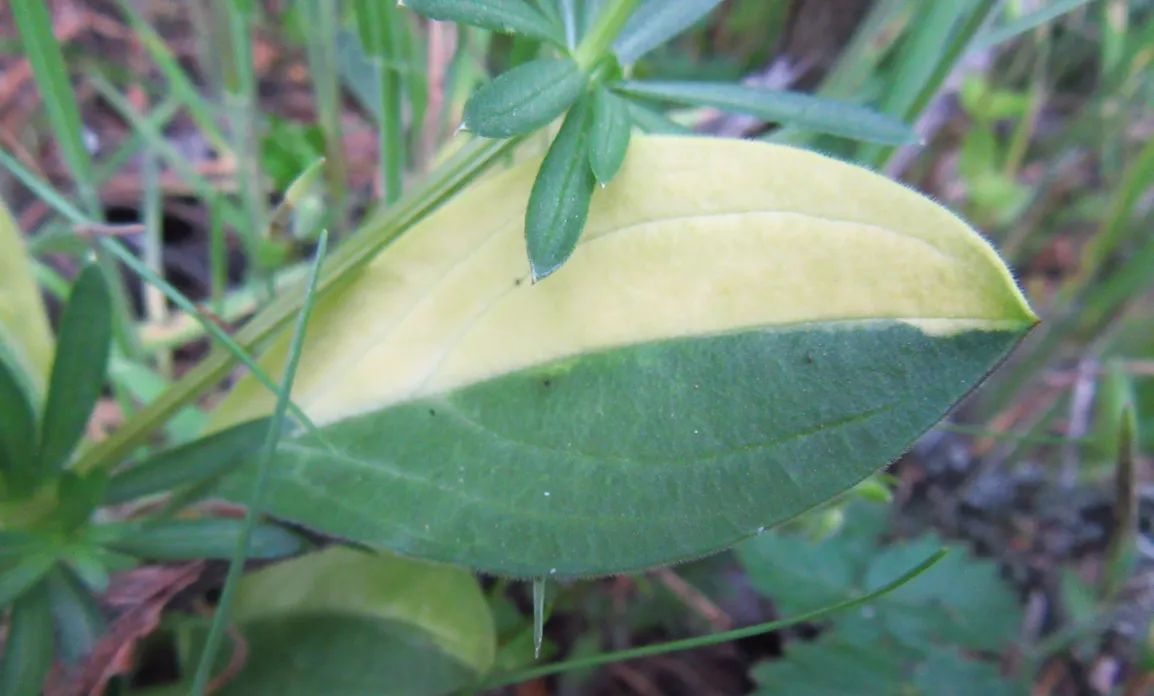
It was a Hoary Plantain (Plantago media), a plant usually so humble it barely warrants a second glance. But this specific specimen was special. One of its leaves was split almost perfectly down the middle: one half a deep, healthy forest green, the other a pale, luminous cream-yellow.
In the world of botany, this is known as a sectoral chimera.
It is a rare genetic 'fork in the road' that happens at the cellular level. Early in the leaf’s development, a group of cells lost the ability to produce chlorophyll, which is of course the very engine that turns sunlight into life. In a sectoral chimera, that mutation follows a strict geometric line, resulting in a leaf that almost looks like it was carefully painted by a steady hand.
I went closer to get a better look. Unlike its cousin, the Greater Plantain (Plantago major), which is smooth and leathery, the Hoary Plantain is covered in fine, silvery hairs. On the yellow half of the leaf, these tiny hairs caught the light, giving the plant an almost ghostly glow.
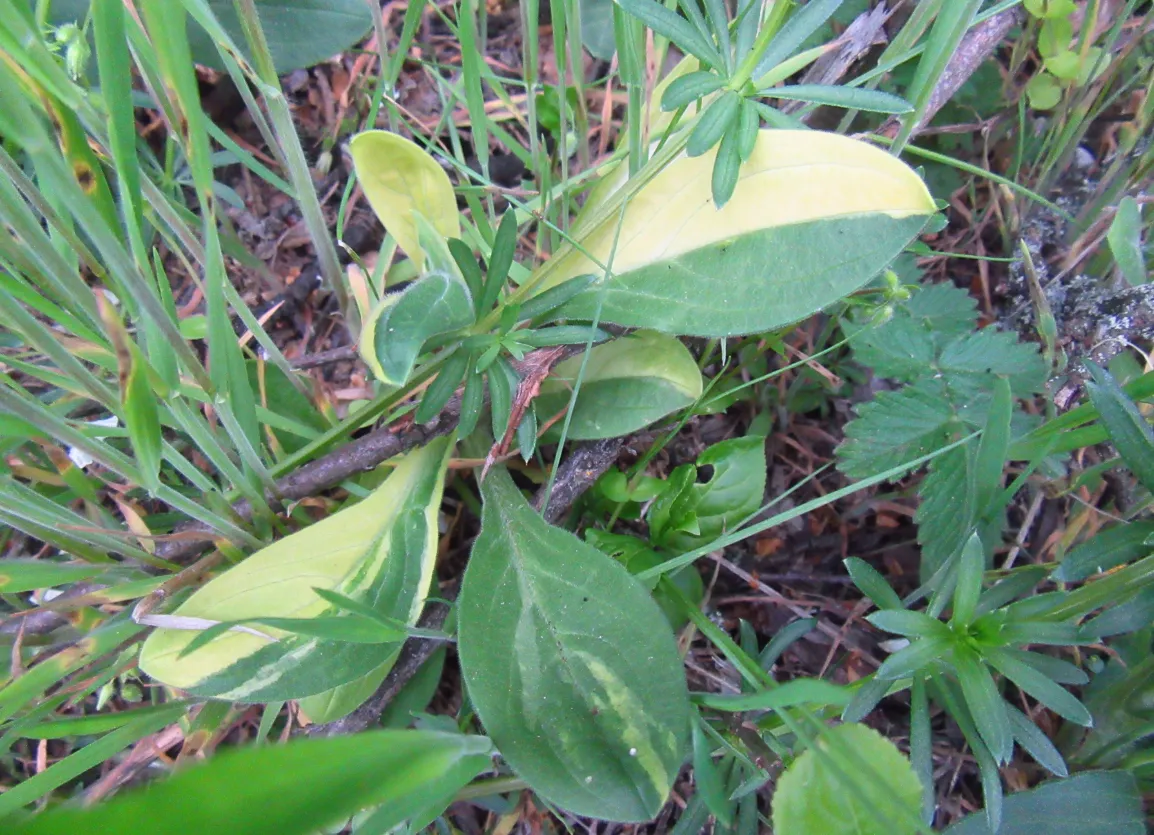
It is a beautiful mistake, but a precarious one. What makes it even more fleeting is that this pattern almost certainly won’t carry forward.
This kind of variegation isn’t written into the plant’s full genetic blueprint. It’s a local error, a mutation in a specific layer of cells in the growing tissue. The parts of the plant that produce seeds are usually unaffected, which means that any offspring will revert to the standard, fully green form. So even if this plant manages to flower and set seed, its descendants will almost certainly look like all the other Hoary Plantain along the path.
This is not a new variety. It’s a one-time deviation.
I uploaded it to iNaturalist and to my surprise I got messages congratulating me with the first documented observation of this mutation in this species. It feels like getting an achievement in a difficult video game. And I have to admit, knowing that I'm the only one who has seen one in real life (or at least the only one who recognized it and took a picture of it), does make you feel good for a moment.
In the wild, variegation is a disadvantage. Without chlorophyll, the yellow side of the leaf is essentially 'freeloading' on the energy produced by the green side. It makes the plant slower, weaker, and more fragile.
While I sat there, I realized the precariousness of its position. This field edge is destined to be mown soon. So this plant would likely be cut down before it ever had a chance to send up its pale lilac-pink flower spike.
It left me with a naturalist’s dilemma. Do we leave these anomalies to the harsh cycles of the field, or do we intervene? Should I save it and bring this 'living mistake' home? In the end I decided to just leave it there and visit it from time to time, to see how it develops. Will the new leaves also be two-toned, or will they just be green?
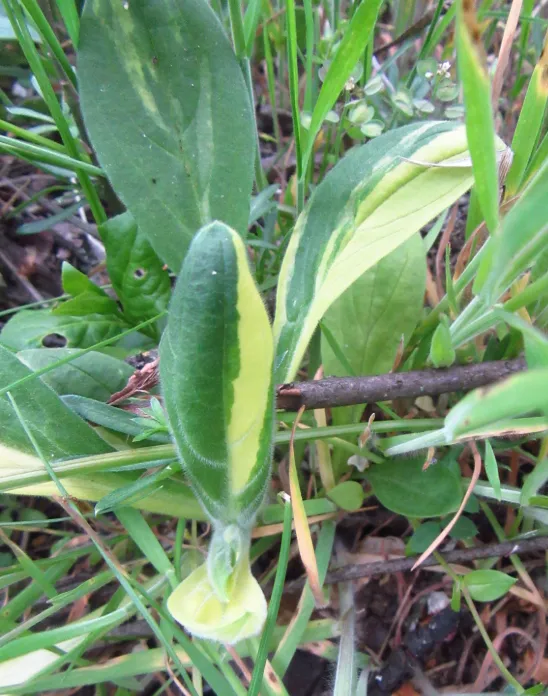
I could have dug it up, given it a place in my garden and even try to make it a new nativar by cloning it through division of the roots, to see if the mutation will carry on through multiple generations. There isn't a cultivar for this species yet, so I could be the one to develop it. But do we really need yet another cultivar? Or since it's from a native plant, a 'nativar' as it would be advertised in today's commercial plant centers?
Sometimes, the most beautiful thing you can find in a field isn't the perfect flower, but the one that got it 'wrong' in the most spectacular way. And sometimes it is enough to be able to just go and look at it from time to time.