The Plant That Turns Red When It's Struggling
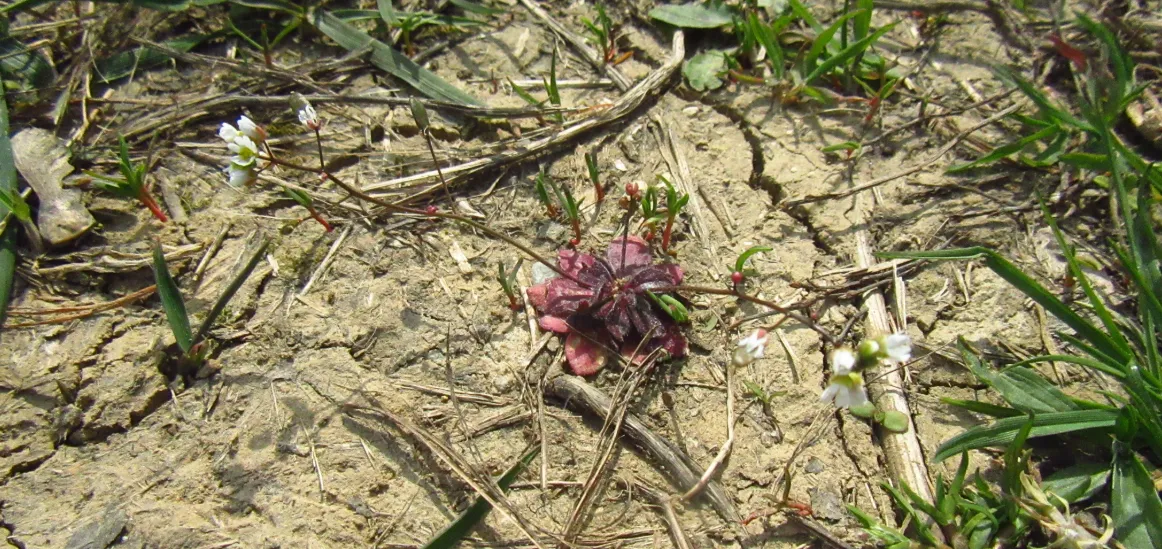
We've had almost no rain this spring. The ground in the drier parts of the garden has already started cracking, and the fields around here look more like late July than early April. Walking the dogs yesterday, I noticed a small patch of deep red among the brown and grey of the cracked earth; the kind of colour that doesn't belong there, that makes you stop and look twice.
My first thought, briefly, was sundew. Drosera has that same deep reddish colour, that same low-growing, almost jewel-like quality. But sundew grows in bogs and wet heathland, not in baked clay in southwestern Hungary. I crouched down for a closer look and to take some pictures, because I just couldn't place it. Looking it up when I was back home, it turned out to be Draba verna, commonly known as early Whitlow grass. A plant I've seen dozens of times in its usual green form, but never like this; wine-dark, almost burgundy, and flowering.
The Red
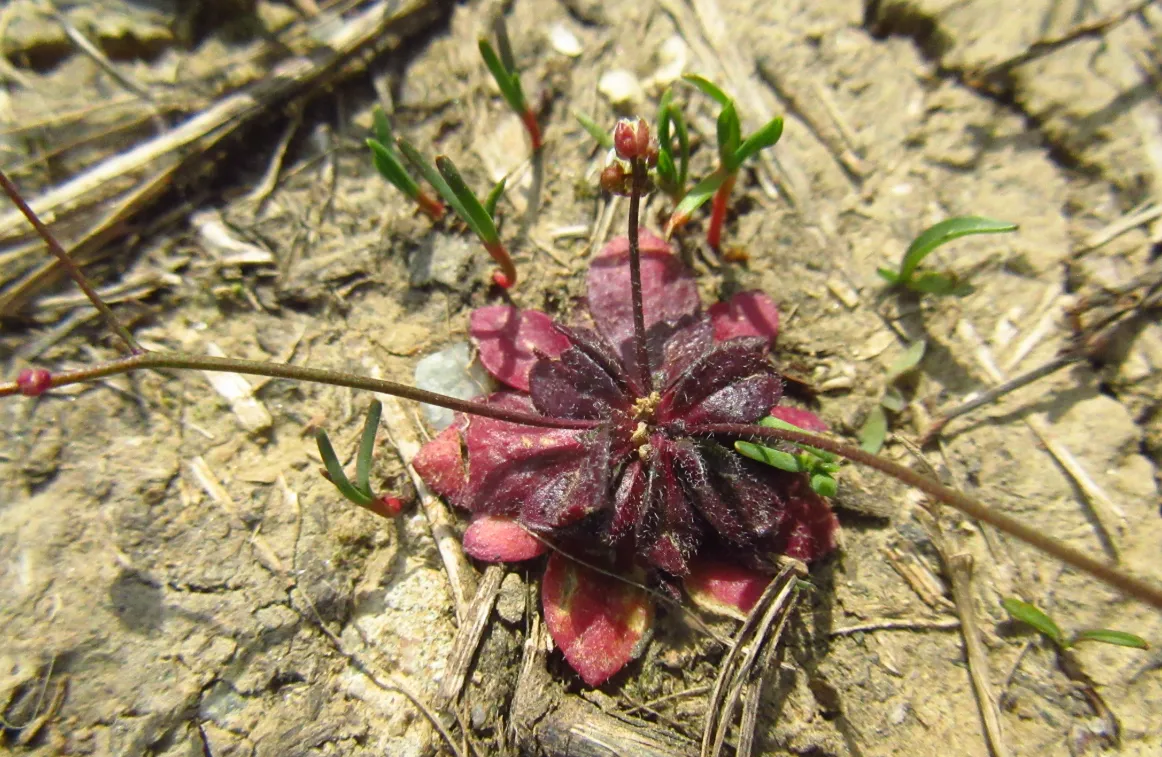
The colour is the first thing worth explaining, because it's what made me stop and threw me off.
Draba verna is not naturally red. In comfortable conditions, reasonable moisture and moderate light, it grows as an unremarkable green rosette, easy to overlook because it just blends in. But this spring has been anything but comfortable. Weeks of dry weather, intense sun on bare soil, wide temperature swings between cold nights and warm afternoons. It turns out, that under these conditions, the plant starts producing anthocyanins, which are the same pigments that colour autumn leaves red.
Anthocyanins do several things simultaneously. They act as a sunscreen, absorbing wavelengths of light that could damage the plant's photosynthetic cells and they act as antioxidants, neutralising the damage caused by stress. In some species they may even lower the freezing point of cell fluids slightly, providing a small buffer against late frosts.
The red colour is the plant's stress response made visible. A green Draba verna is comfortable. A red one is coping and the vividness of the colour is a measure of how hard it's working. The most stressed individuals are often the most intensely coloured, and in harsh conditions, frequently the healthiest plants in the population. The colour that made me stop and look is the plant showing me, involuntarily, that it has not given up.
The Quick Life
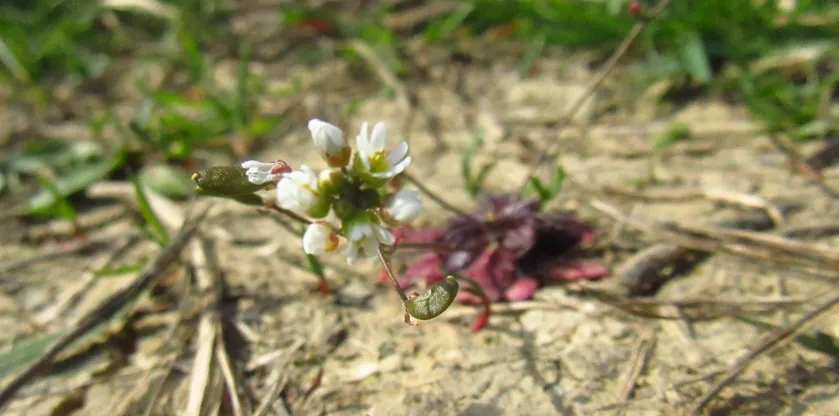
What Draba verna is doing in cracked, bare clay in early April makes sense once you understand its strategy.
This is a plant that does everything fast. It germinates in autumn, overwinters as a tiny rosette pressed flat against the ground, flowers in early spring, sets seed, and dies. It does all of this before summer arrives and before most other plants have properly woken up. By June it will be gone completely, leaving nothing but seeds in the soil, waiting for autumn.
The bare, dry ground that most plants avoid is exactly where Draba verna thrives, because there is no competition. It doesn't need to out-compete anything. It just needs to be first. And in a spring as dry as this one, on ground that has already been cracking, it is the only thing flowering in that patch of earth.
Each of those tiny seed pods already forming on the stems, while the flowers are still open, contains up to forty seeds. The plant is simultaneously flowering and fruiting, hedging every bet, making sure the next generation is underway before anything can stop it.
Perspective
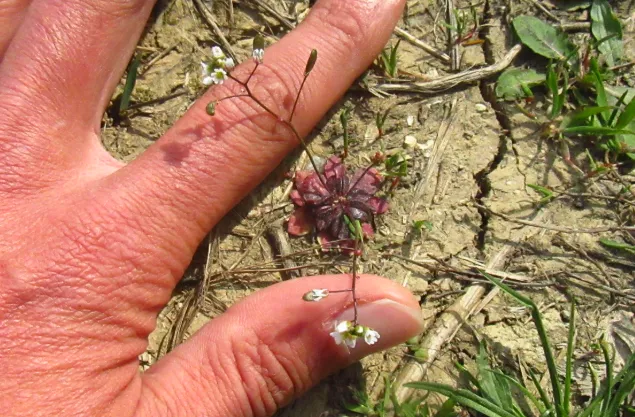
My hand in the photograph is there for scale, because without it the plant is difficult to place. The rosette at the base is roughly the size of a thumbnail. The flowering stems reach perhaps a centimetre or three above the ground. The individual flowers are about three millimetres across, white, four-petalled and each petal so deeply notched it looks at first like eight.
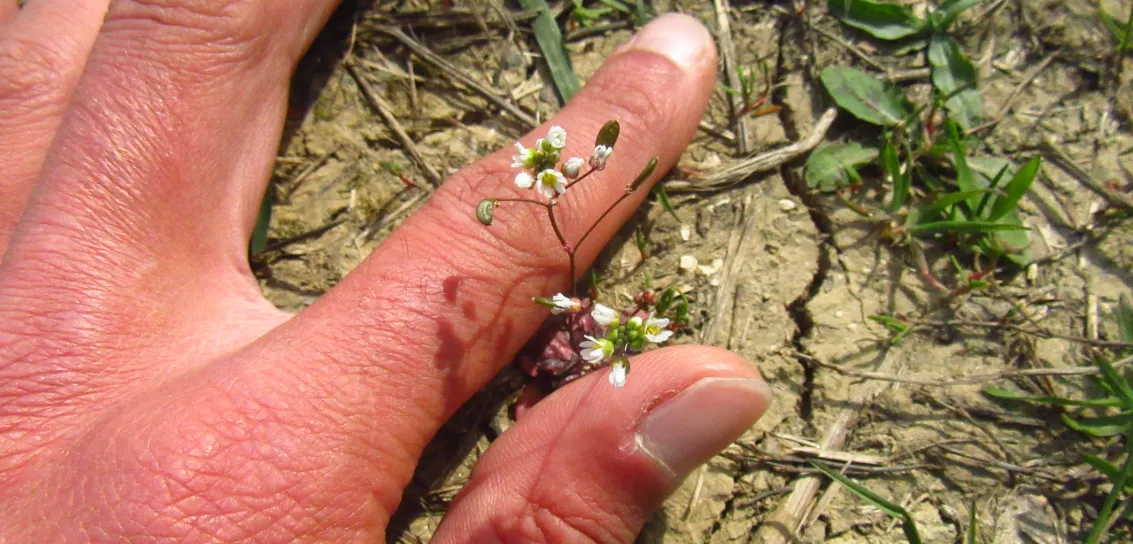
A complete plant, in a space smaller than a fingernail, on ground that looks like nothing could live there. It reminded me of sundew, that first glance. The colour (which in sundew is also a result of anthocyanins), the low-growing intensity of it and the sense of something alive in a place that seems inhospitable. Sundew traps insects. Whitlowgrass just survives, which in this spring, on this ground, is impressive enough.