An Ancient Hunter in the Vineyard
Imagine a world 300 million years ago. The first dinosaurs wouldn't appear for another 70 million years. The Earth was dominated by massive swamp forests, giant ferns and towering lycopsids. In the undergrowth of this Carboniferous world, a specific biological blueprint was perfected, and if you know where to look in the undisturbed woodlands of Central Europe today, you can still find its descendants.
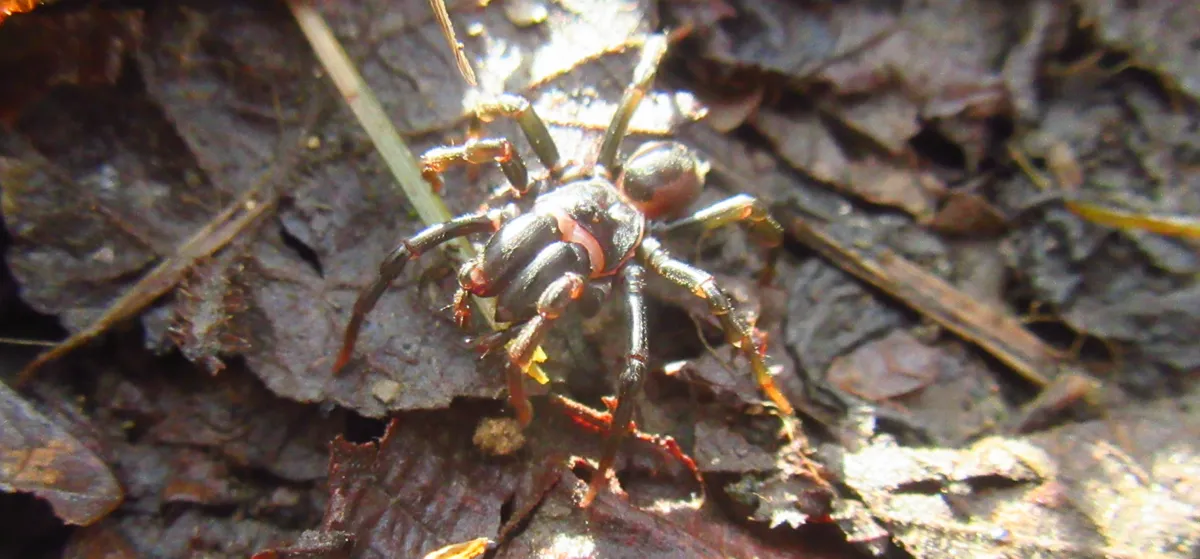
Yesterday I was lucky enough to find one of those descendants. I wasn't searching for it. I just noticed an unusual spider crawling between the rows of grapevines where I was working.
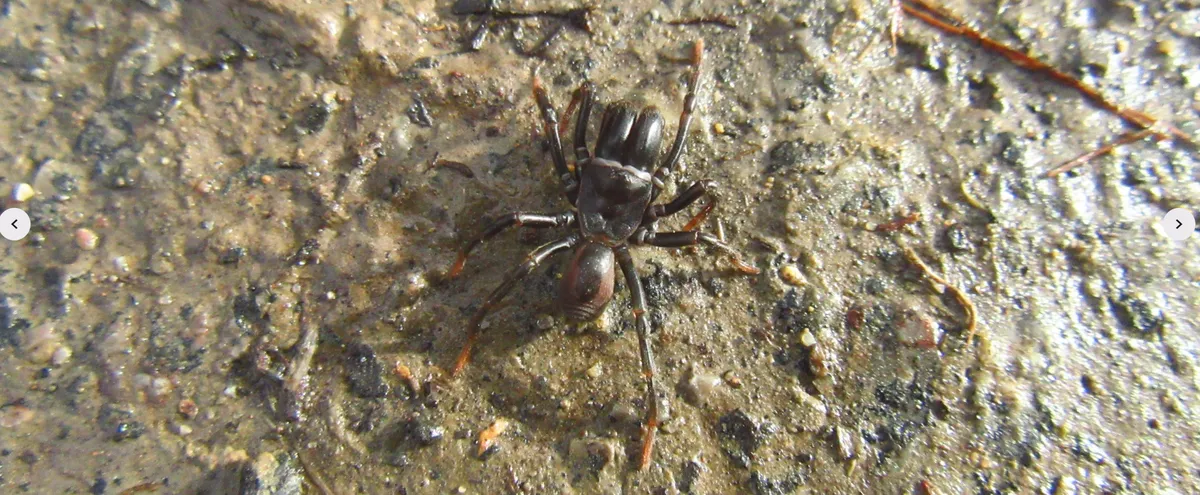
The vineyard came with the house and is simply too big for us. It has about 650 grapevines, and while I can appreciate a good glass of wine now and then, I don't plan on going to the trouble of making the wine myself. So I was removing some of the vines to make room to plant some kiwi plants and berries, and suddenly I saw it crawling, so I took some photos to identify it later. It might look rather big on these pictures, but in fact it's just a little spider, a male, measuring barely 8-9 mm, so I had to zoom in and crop the images quite a bit.
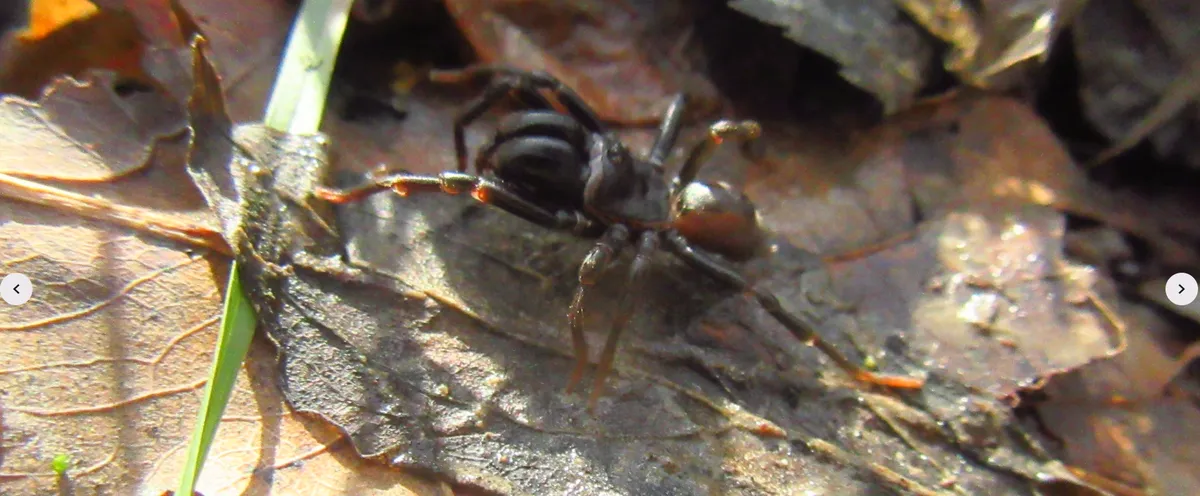
Today, I want to tell you the story of the Purse-web spiders (the Atypus genus), a lineage that haunts our forests and fields (and apparently also our vineyard) as a living artifact of ancient times.
The Great Evolutionary Split
Around 300 million years ago, the spider family tree hit a major fork in the road. On one side, you have the 'modern' spiders (Araneomorphae) that most of us see every day. They evolved to have fangs that pinch together like tweezers, allowing them to build intricate aerial webs.
On the other side are the 'old' spiders, the Mygalomorphs. This is the lineage of the heavyweights: tarantulas, trapdoor spiders and funnelwebs. They kept the 'old-school' machinery; massive, parallel fangs that strike straight down like daggers. While their modern cousins went on to conquer the air with their webs, the Mygalomorphs stayed grounded.
If you travel to the tropics or the Mediterranean, Mygalomorphs are everywhere. But as you move north into Central Europe, the lineage almost entirely vanishes. Here, in Hungary, four resilient species have managed to remain. The rare Nemesia pannonica, which hides in the grasslands, and the three species of Atypus. They stand as the primary guardians of this ancient tarantula lineage in cooler climates. They are biological outliers: 'tropical' designs perfectly adapted for the European winter.
The Invention of the Silk 'Purse'
The survival of this species for hundreds of millions of years is due to a piece of prehistoric engineering: the purseweb.
Instead of spinning a web in the bushes, the Atypus builds a vertical, finger-like silk tube, almost like a sock, completely closed at the top. Most of it is buried deep in the soil, but a few centimeters poke out above the leaf litter. To a passing beetle, it looks like a harmless, dirt-encrusted twig. To the spider waiting inside, it is a sophisticated vibration sensor.
When prey steps on the tube, the spider strikes through the silk wall, impales the victim with those ancient, downward-striking fangs, and pulls it into the bunker. This 'landmine' strategy has been so effective that the spider has never had an evolutionary reason to leave its hole or change its appearance. It's only the males that dare to venture out in the open for a short time, searching for a female. This happens mostly in autumn, so finding one on the first sunny days of winter, like I did, is even rarer. It must be a male that is quite desperate to find some 'sweet sweet love'.
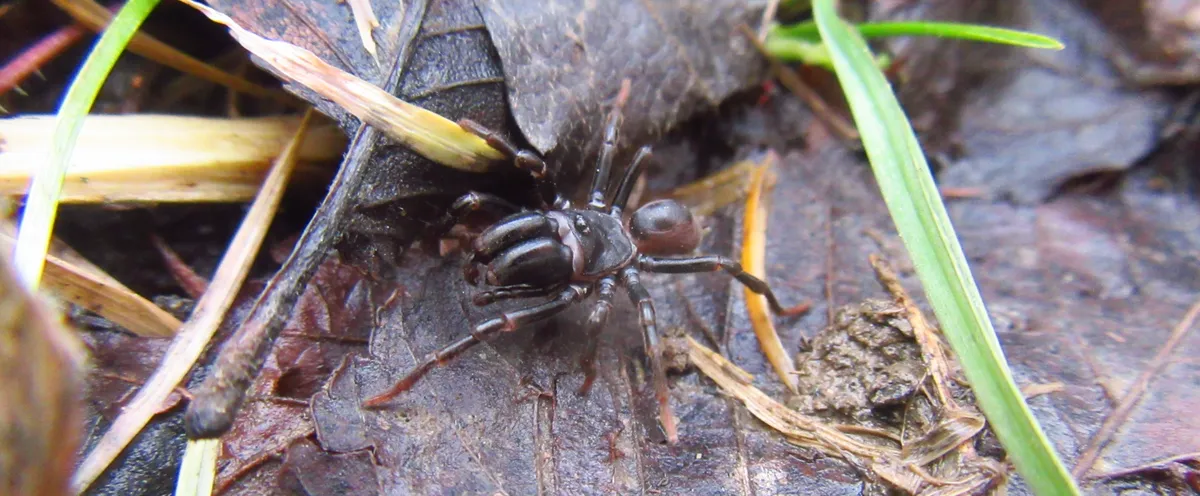
Because Atypus is so tied to its silken bunker, often living in the same hole in the ground for nearly a decade, it cannot survive in habitats that have been plowed, paved, or chemically treated.
Finding one today is a signal from the past. It serves as a biological indicator, a living certificate that the soil it inhabits is undisturbed. Here in Hungary, their rarity and ecological importance have earned them legal protection.
If you would also happen to see one someday, remember that you're looking at a design that saw the rise and fall of the dinosaurs and decided it didn't need to change a single thing, and just for a moment, think about how remarkable that actually is.