The Bees That Live Underground
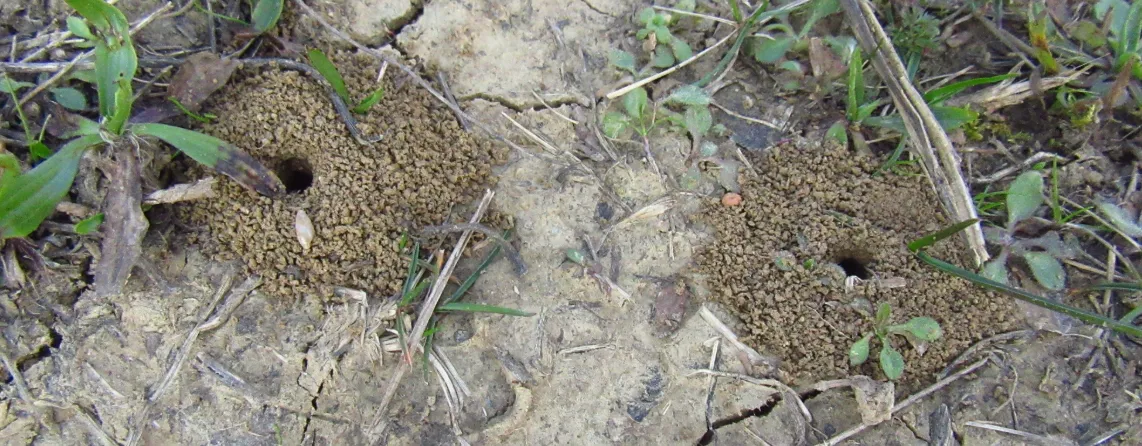
This morning, when taking the dogs for a walk, I nearly walked on them without noticing.
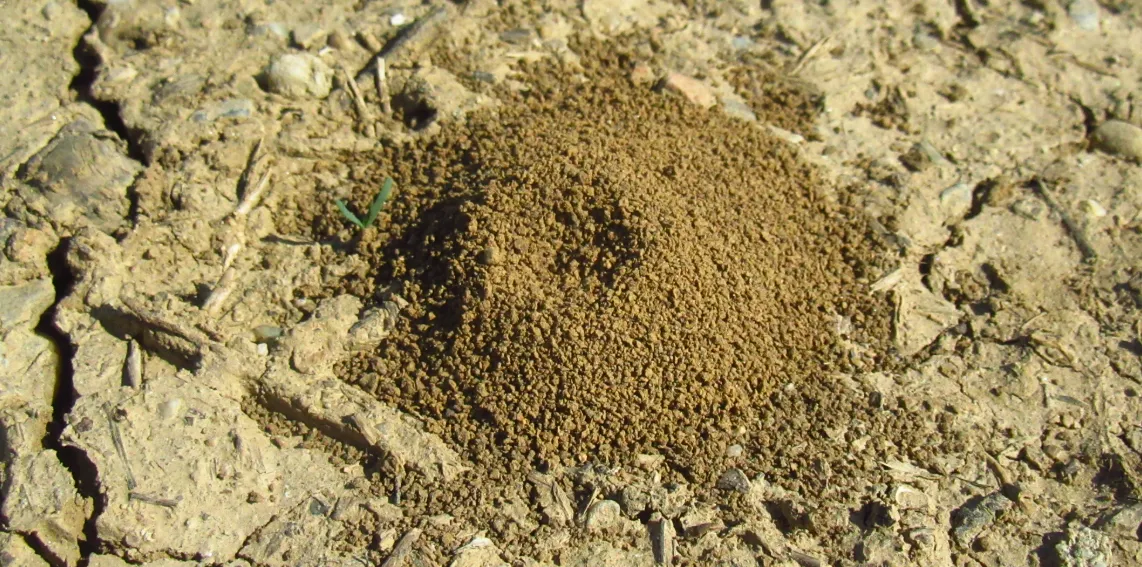
Small mounds of loose soil, scattered across the bare patch of ground between the sheep meadow and the vegetable garden. Each one with a neat round hole at its centre. From a distance they look like nothing in particular, a disturbance in the soil, maybe worm activity, probably nothing worth stopping for.
I stopped.
A City Under the Ground
These are the nest entrances of mining bees, almost certainly Andrena, a genus so large, with over 1,500 species worldwide, that it is one of the biggest animal genera on Earth. Several species are active here in early spring, and telling them apart without close examination and some expertise is genuinely difficult. What I can say with confidence is what they are doing, and why the patch of bare ground they chose matters.
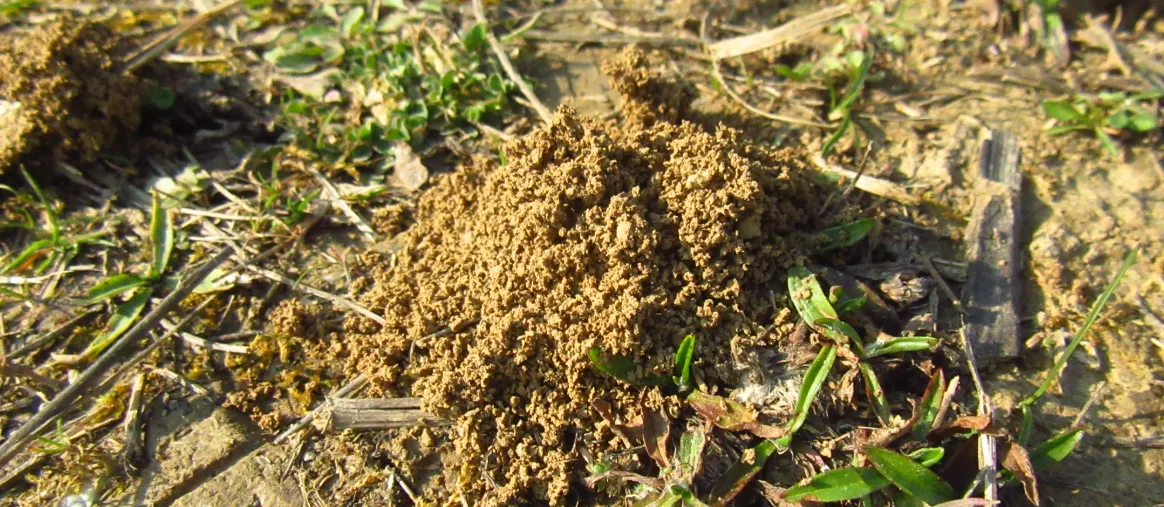
Each mound is the work of a single female. She excavates a vertical tunnel, sometimes reaching 20 centimetres or more into the soil, and off that main shaft she carves a series of small side chambers. Each chamber gets lined with a waterproofing secretion, packed with a ball of pollen and nectar, and sealed with a single egg on top. Then she moves on to the next one.
The soil excavated during this process forms the small mound we see around the entrance. The ones in my photos are textbook examples. Neat, fresh, the soil visibly darker than the ground around it.
She does all of this on her own.
Solitary, but Not Lonely
Mining bees are solitary in the strict sense. There is no queen, there are no workers, no shared colony. Each female builds and provisions her own nest entirely on her own. And yet they often nest in dense aggregations, with dozens or hundreds of entrances clustered together in the same patch of ground.
Some aggregations have been recorded with dozens of nest entrances in an area barely larger than a square metre, entrance holes sometimes only a few centimetres apart. These bees are solitary, but they certainly don't mind being close to their neighbours. It is less like a colony and more like a street full of houses, everyone with their own front door, their own rooms, their own provisions, but living in close proximity by choice.
Why do they aggregate? Partly because suitable nesting conditions are patchy. Bare, well-drained, slightly compacted soil in a sunny position is not available everywhere, and when a good site exists, many females converge on it. There may also be some safety in numbers. A large aggregation can be harder for predators and parasites to work through efficiently than a single isolated nest.
The Bee on the Leaf
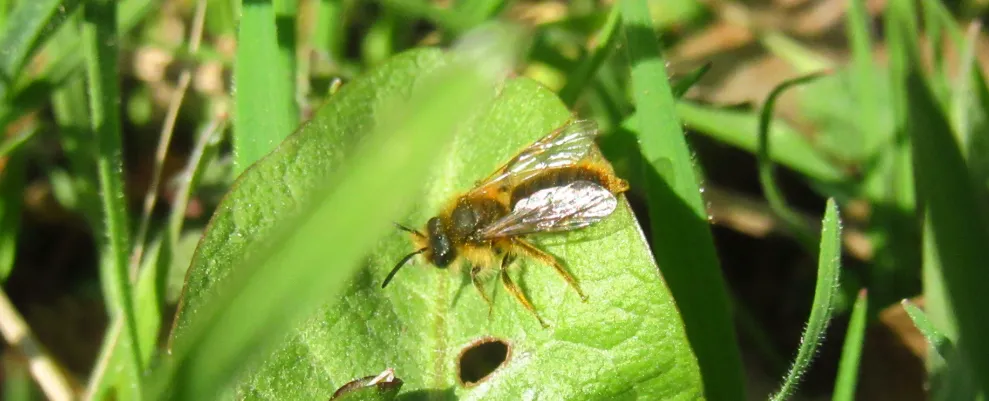
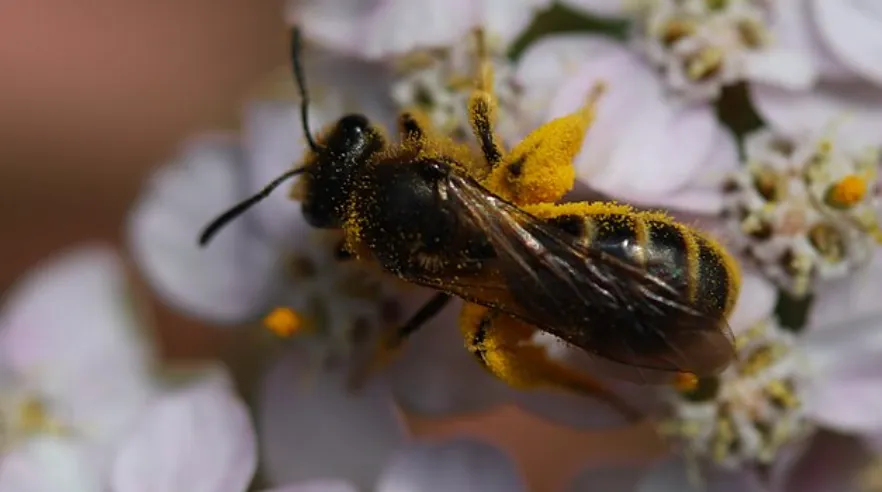
One of the females stopped long enough to photograph properly. The build, the timing, and the dandelions flowering nearby all point toward Andrena taraxaci, the Dandelion Mining Bee, a species that emerges early in spring and has a particularly close association with dandelions and other composites. She times her emergence to coincide almost exactly with when they flower, which is either a remarkable coincidence or, more likely, the result of millions of years of very careful calibration.
I've submitted the photographs to iNaturalist and will update this if someone with more expertise disagrees. With Andrena, disagreement is always possible.
The Darker Bee
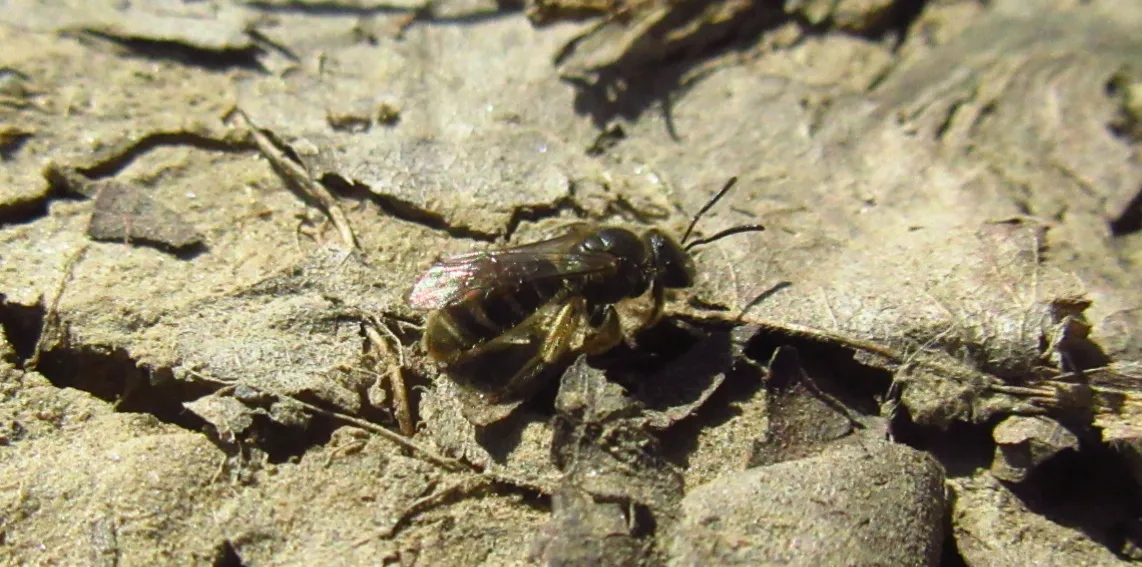
The other bee I saw emerging from one of these holes is a different story.
The build and size suggest Lasioglossum, a vast genus of sweat bees with hundreds of species across Europe, many of which are essentially impossible to separate without microscopy. They are small, often dark or weakly metallic, and easy to overlook entirely. I know roughly what I'm looking at. The species will have to remain a question mark for now.
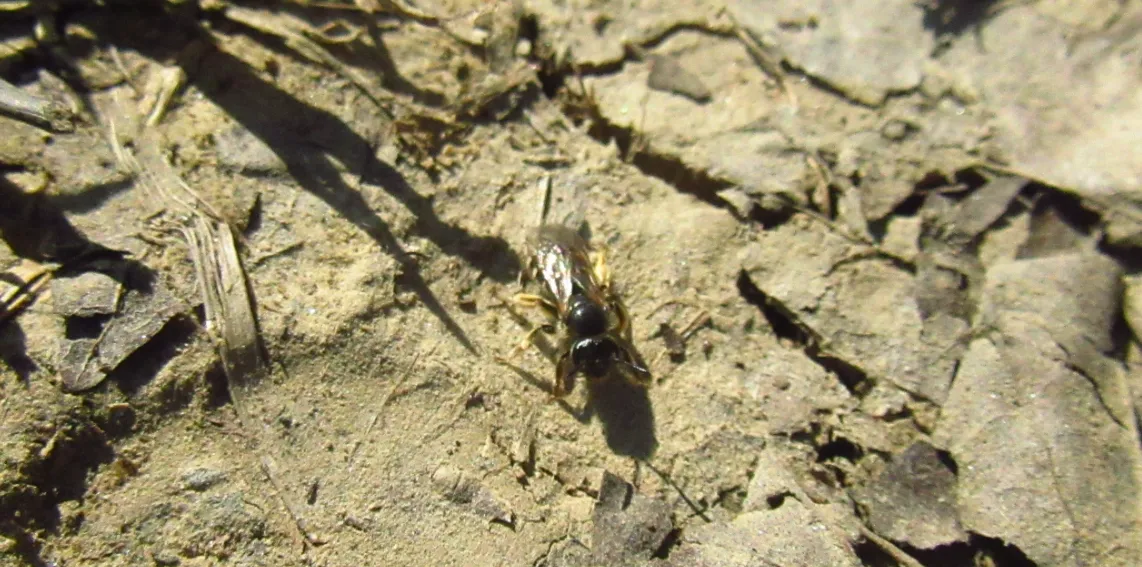
Lasioglossum bees are worth a mention beyond the identification puzzle, though. Many species in this genus show a fascinating range of social behaviour, from completely solitary to primitively eusocial, with small colonies where a dominant female does most of the reproduction while her nestmates do most of the foraging. They sit at an interesting evolutionary midpoint, somewhere between the solitary lifestyle of Andrena and the highly organised colonies of honeybees. Catching one here near an Andrena aggregation shows how many different solutions to the same basic problem; how to raise their offspring, exist within a single family of insects.
What the Bare Ground Is For
In gardens, mining bee nest entrances are often mistaken for worm casts or simply overlooked. Most people who notice them assume something is wrong and reach for a rake.
Nothing is wrong.
That patch of bare, compacted ground next to the vegetable garden, the kind of path we made simply by walking over it every single day, is exactly what these bees need. Loose, well-drained soil. Full sun for most of the day. No disturbance. The sheep graze around it. The dogs sniff at it and move on. And every spring, the females return and open their tunnels again.
The same nesting sites are often used year after year, new females returning to the same patches their mothers used. I don't know how long this particular aggregation has been here. It was already here when we arrived. It will, I hope, still be here long after we've gone.
Adults are only active for a few weeks. By late spring the entrances will be sealed, the females gone, and the patch of bare ground will look like nothing again. Underground, in sealed chambers lined with wax and packed with pollen, next year's bees will be waiting.