The King of the Birds
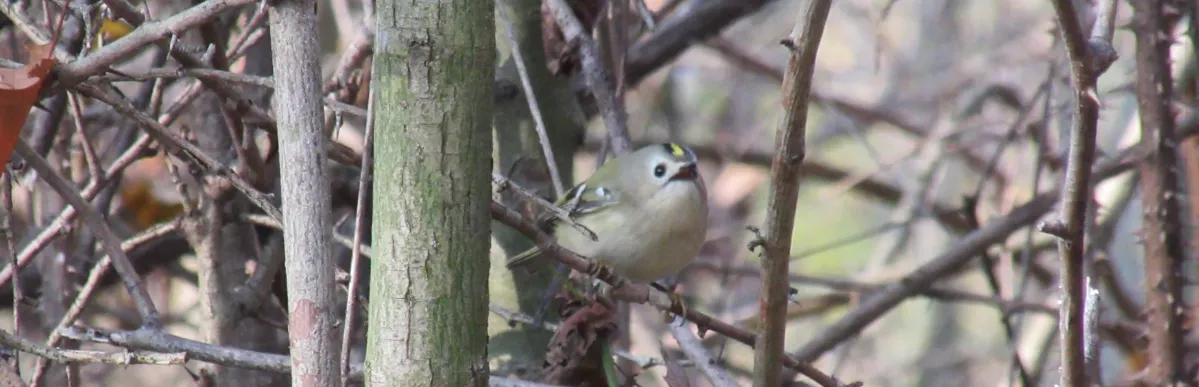
This morning I finally managed to photograph a Goldcrest. I have regularly heard and seen them over the past month, but they are such small birds, always in motion and so fast, that I had not yet succeeded in actually taking a photo of one. This morning, however, one decided to take a rare moment of rest on a twig close to where I was standing. You can see the result above. I couldn’t take many photos, because she soon decided to disappear back into the vegetation and continue foraging, but I still consider myself lucky that I was able to get these shots.
Apart from the small group that has been hanging around here for a while now, I have only rarely seen them. One about twelve years ago, on holiday in France, and another about three years ago during a walk through the forest a few villages away. It’s not that they are particularly rare, but they are small and generally stay high up in the trees, and therefore often go unnoticed. They have a preference for conifers, spruces in particular. The one I saw apparently thought differently, because apart from a single conifer in someone’s garden, this area consists entirely of deciduous trees. This one was sitting in the scrub, searching for insects among the brambles, wild roses, young acacia saplings, and hawthorn.
A rough estimate of the population is 98 to 165 million adult birds, occurring from the British Isles straight through the conifer belt across Asia all the way to Japan. So fortunately, they are not currently threatened with extinction.
It is the smallest bird we have in Europe. They weigh barely 5 grams (the same as 5 paperclips), are 9 cm long (including the tail), and have a wingspan of 14 cm. Worldwide, there are only a handful of other birds that are smaller and lighter.
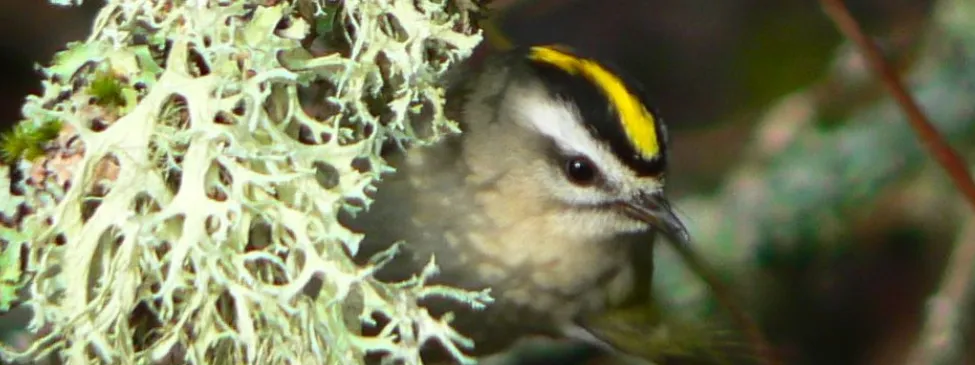
Where the common name, Goldcrest, comes from is fairly obvious and does not show much creativity. The crown of the head has black sides and a narrow black front, and a bright crest, yellow with an orange centre in the male, and entirely yellow in the female. The one in my photo is therefore clearly a female.
The scientific name of this little bird comes with a much nicer story. Aristotle (384–322 BCE) wrote about the legend of a contest among the birds to decide who should be their king. The title would be awarded to the bird that could fly the highest. So they all took flight, and initially it seemed as though the eagle would win easily, soaring high above the others. But as he began to tire, our goldcrest, which had hidden under the eagle’s tail feathers, emerged and, with a few flaps of its wings, launched itself from the eagle’s tail to fly even higher and claim the title. Huzzah! Because of this feat, it was also rewarded with the scientific name Regulus regulus, which means “petty king.”
He may be the King of the Birds, but that does not mean he has an easy life. The average life expectancy of a goldcrest is barely 8 months. Eighty percent do not survive their first year. Still, some do live longer. The oldest one we know of was ringed in the nest in the UK and found dead in Morocco 7 years and 7 months later.
The greatest danger, apart from being caught by a bird of prey, is freezing during the long, cold winter nights. They maintain normal body temperatures during cold nights by metabolising fat laid down during the day, and they use behavioural thermoregulation strategies, such as collective roosting in dense foliage or snow holes, to survive the harsh winter nights. Two birds roosting together reduce their heat loss by a quarter, and three birds by a third. During an 18-hour winter night, with temperatures as low as −25 °C in the north of their range, goldcrests huddled together can each burn off fat equivalent to 20% of their body weight to keep warm.
So it is a matter of eating to survive and rebuilding fat reserves every single day, whether it is snowing, raining, or freezing. All Regulus species are almost exclusively insectivorous, preying on small arthropods with soft cuticles, such as springtails, aphids, and spiders. They also feed on the cocoons and eggs of spiders and insects, such as moths. The goldcrest feeds in trees, frequently foraging on the undersides of branches and leaves, taking the smallest prey items ignored by other species. So they have to eat a lot, which means they don’t have time to loiter or sit still for me while I try to take a picture. For them, it is a matter of life or death to find enough food before the sun starts setting. That's why I make sure I leave the stems from the flowers, the leaves on the ground and woodpiles everywhere in my garden. It provides a lot of places for insects to hide and to deposit eggs, and it helps the little birds like these goldcrests to survive the winter months.
Those that survive the winter therefore do everything they can to compensate for the losses of the winter months. The female lays up to as many as 12 eggs, and while the male is still busy feeding all those hungry mouths after the eggs have hatched, the female often already starts incubating a second clutch. So with a bit of luck, there will be a new generation to play hide-and-seek with me next year, challenging me to get them on camera.
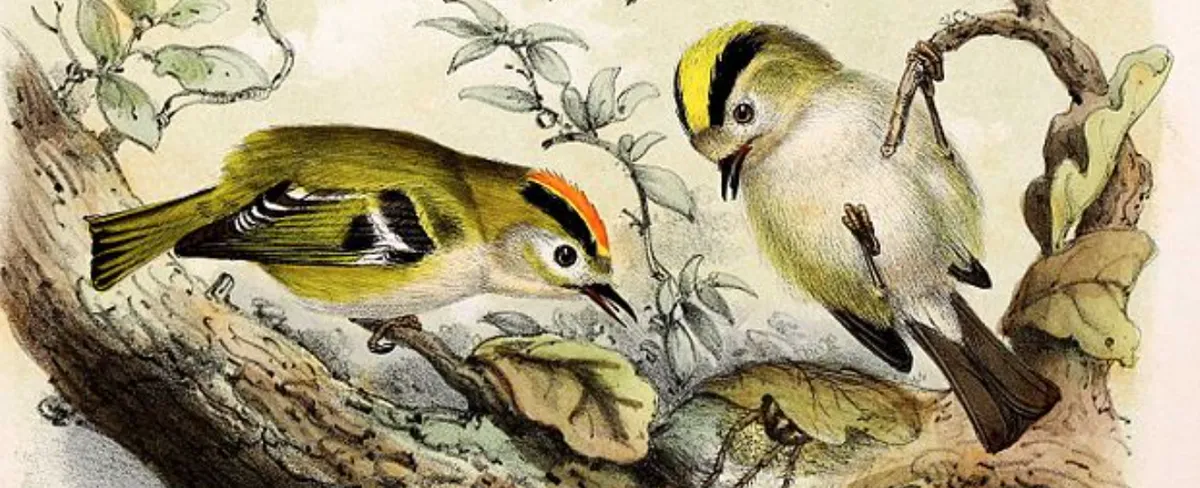
The Gold-Crested Wren by Turner, Charles (Tennyson) (1808–1879)
When my hand closed upon thee, worn and spent
With idly dashing on the window-pane,
Or clinging to the cornice — I, that meant
At once to free thee, could not but detain;
I dropt my pen, I left th’ unfinished lay,
To give thee back to freedom; but I took —
Oh, charm of sweet occasion! — one brief look
At thy bright eyes and innocent dismay;
Then forth I sent thee on thy homeward quest,
My lesson learnt — thy beauty got by heart:
And if, at times, my sonnet-muse would rest
Short of her topmost skill, her little best,
The memory of thy delicate gold crest
Shall plead for one last touch, — the crown of Art.